

Introduction
Welcome to our latest blog post, where we delve deeper into the concept of the ‘Wheel of Life’. In our previous post, we focused on defining our values – the inner compass that guides us. Now, we’re taking it a step further. Life comprises various segments that require attention and balance. In this blog post, we’ll score each segment, examine whether they’re in balance, and shape a future vision for them.
This enables us to pursue a fuller and more balanced life. Let’s embark on this journey together!
The Wheel of Life and the 8 Life Areas
The Wheel of Life: A Tool for Understanding Different Aspects of Life
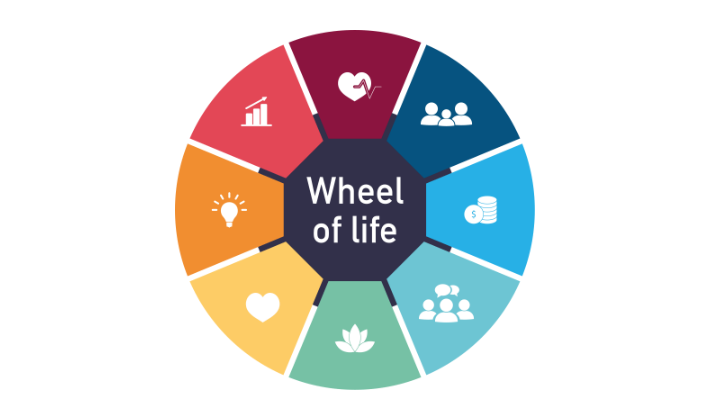
The Wheel of Life is a powerful tool that can help us gain better insight into the different facets of our lives. It’s a circle divided into eight segments, each representing a significant life area. I chose the eight in this article myself, as I find them personally important. You’re free to choose your own areas. However, keep in mind that many of these life areas strongly influence each other. For instance, health will always have a fundamental effect on the rest. It’s a life area that always requires attention.
The 8 Life Areas
The life areas I propose are:
- Health and Fitness: This area encompasses everything related to our physical health and fitness. It’s not just about how often we exercise or how healthy we eat, but also about how well we take care of our bodies. To me, health is much more than the absence of disease. It’s a body full of energy, resilient, and allowing you to lead a full life.
- Character: This is about our personal integrity. Are we living according to our values? It also concerns the extent to which we demonstrate the character traits we admire and appreciate.
- Emotional Life: In this segment, we look at our emotional stability and how well we handle stress and negative emotions. It also involves how often we experience positive emotions such as joy, happiness, or satisfaction.
- Relationship with Partner: This segment focuses on our satisfaction with our current relationship, how often we genuinely connect with our partner, and how effectively and respectfully we communicate.
- Parenting: Here, we assess ourselves as parents, the bond we have with our child(ren), and our ability to support and guide them on their life path.
- Personal Development: This segment relates to our pursuit of learning and growing. To what extent do we improve our weaknesses and develop our strengths? How often do we challenge ourselves to step out of our comfort zone? This segment, like health, has a significant impact on the other life areas.
- Work: This is about our satisfaction with our current job or career. Do we find fulfillment in our work? Are we on a path that enables growth and progress in our career?
- Financial: In this last segment, we look at our satisfaction with our current financial situation. Are we able to pay our bills while saving for the future? Do we have a financial plan or goals we’re striving for?
By using the Wheel of Life, we can get a clearer picture of where we currently stand in each of these areas, and where we want to go. It helps us understand where we need to devote our energy and attention to create a more balanced life that brings greater satisfaction.
The Importance of Balance in Life Areas
Why Balance is Essential for Well-being and Happiness
Striving for balance in all life areas is essential for our overall well-being and happiness. After all, life is an intricately woven tapestry of different aspects, and no single area stands alone. Ignoring a particular area, such as health and fitness, can impact other areas, such as our emotional stability or ourrelationships. Therefore, striving for balance is crucial.
Just Like a Wheel of Your Car
I learned about the Wheel of Life in Tony Robbins’ Time of your Life program. There, Tony drew a comparison between the Wheel of Life and a car wheel. If one of the wheel’s segments is not well balanced, the entire wheel will roll unevenly. Similarly, in life, if a life area is out of balance, it can disrupt our overall sense of satisfaction and fulfillment. Hence, it’s essential to devote equal attention and care to all life areas, maintaining a smoothly rotating ‘wheel’ that helps us navigate life with ease and joy.
The faster you drive your ‘life car’, the more critical this balance becomes.
The Importance of Self-Reflection and Self-Knowledge
The Role of Self-Reflection
Just like navigating with a GPS, it’s not only important to know where we want to go, but also where we are now. Therefore, self-reflection and self-knowledge play a crucial role in determining our current position in the life areas. Without an honest evaluation of where we stand, we won’t be able to chart a clear path to where we want to be.
Answer the Questions ‘As Is’
Questions like “How do you rate your current physical health?”, “Are you living according to your values?” or “How satisfied are you with your current relationship?” can help us get a realistic picture of our current situation. They invite us to dig deeper and be honest about our strengths and weaknesses, our joys and challenges.
It’s important to remember that this self-reflection is not meant to criticize or judge ourselves. Rather, it’s to increase our awareness and deepen our understanding of ourselves. In this way, we can identify areas where we can devote more attention and care. Over time, we can look back and celebrate our progress and growth. Nothing motivates more than a sense of progress!
Scoring the Life Areas
Score on a Scale of 1 to 10
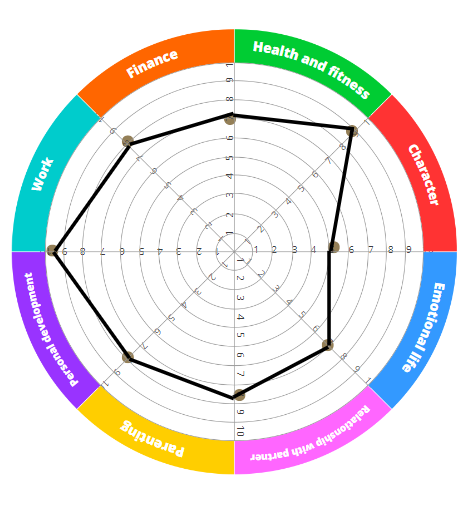
As I mentioned, scoring the life areas brings you closer to understanding where you stand now. It’s an essential step towards personal growth and achieving your goals. Below, I provide a brief overview of the eight life areas and the questions you can ask yourself when scoring each area. Give each segment a score from 1: totally dissatisfied, to 10: perfect!
I recommend doing this exercise at a quiet moment, so you can truly reflect and be honest with yourself. Prefer to write? You can download and fill out this handy PDF.
Guiding Questions
- Health and Fitness: How would you rate your current physical health? Do you exercise regularly? How well do you eat and take care of your body?
- Character: Do you have a strong sense of integrity? Are you living according to your values? How often do you show the traits you admire in others?
- Emotional Life: How stable do you feel emotionally on a daily basis? How well do you handle stress and negative emotions? How often do you experience positive emotions, such as joy, happiness, and satisfaction?
- Relationship with Partner: How satisfied are you with your current relationship? How often do you genuinely connect with your partner? Do you communicate effectively and respectfully with your partner?
- Parenting: How would you rate yourself as a parent? Do you have a strong bond with your child(ren)? Do you feel capable of supporting and guiding your child(ren) on their life path?
- Personal Development: Are you continually learning and growing? Are you working on improving your weaknesses and further developing your strengths? How often do you challenge yourself to step out of your comfort zone?
- Work-Career: How satisfied are you with your current job or career? Do you find fulfillment in yourwork? Are you on a path that enables growth and progress in your career?
- Finances: How satisfied are you with your current financial situation? Can you pay your bills while simultaneously saving for the future? Do you have a financial plan or are you striving towards financial goals?
When answering these questions, keep in mind that the goal is not to achieve perfection in every area, but to create a balanced and fulfilling life that aligns with your unique values and goals.
Define Your Personal Vision for Each Life Area

Formulate Your Vision for Each Life Area
Now that you’re aware of the importance of balance in life areas and have a sense of where you stand, you’re ready to take a step further: defining your personal vision for each life area. This is a crucial step towards a fulfilling and balanced life, as it gives you direction and purpose. It helps you make conscious choices that bring you closer to your ideal life.
How do you do this? Go through each life area. First, write down your belief about that area. What do you believe about ‘health’ or ‘character’? Then, describe why you find it important and what the ideal situation would be for you. What is ‘perfect health’ for you?
Some Examples
Health and Fitness
- Beliefs: Your belief could be that a healthy and fit body is the key to a long, happy, and productive life. You believe that regular physical activity, healthy eating, and sufficient rest are essential for your overall well-being. You also believe that small daily habits can have significant effects on your health in the long run.
- Why (compelling reasons): Your ‘why’ could be because optimal health and fitness give you the vitality and resilience to live fully, reach your potential, and contribute to the world around you.
- Ideal situation: Your ideal scenario could be that you’re active every day, eat a balanced diet, and get at least eight hours of sleep. You see yourself radiating energy, full of confidence, and ready to tackle any challenge.
Character
- Beliefs: You might believe that your character reflects who you truly are. You value integrity, honesty, courage, and kindness. You believe these qualities help you make a positive impact on others.
- Why (compelling reasons): Your ‘why’ for character development could involve enabling you to consciously determine your own path, adapt to changes, and become the best version of yourself. As a result, you can lead a valuable and fulfilling life.
- Ideal situation: Your ideal situation could be that you always act according to these values, regardless of the circumstances. You want to be known as a person of unwavering integrity and fearless courage.
We follow the same approach for the remaining life areas. First, define your beliefs, then sketch your ideal situation. In this PDF, I give you more detailed examples of how I personally approach each life area.
This process can be time-consuming, but it’s absolutely worth it. It offers you the opportunity to reflect deeply on your values and goals. It enables you to live your life with more purpose and intention.
In the next blog post, we’ll delve deeper into how you can concretize your ‘aspirations’. It seems like a daunting task that requires a lot of willpower. Well… there are solutions for that. We’ll discuss those in a future blog post. Until then, take the time to reflect. Start shaping your personal vision for each life area. Remember: Shoot for the stars; even if you miss, you might still land on the moon!
Conclusion

Summary
In summary, today we’ve taken a deep dive into the world of self-reflection and self-awareness. We’ve seen how important it is to bring our life areas into balance, and discussed some valuable tools to achieve this goal. By defining our personal vision for each life area, we canchart a course towards a more fulfilling and balanced life. Remember, the journey is as important as the destination. So, take your time, reflect deeply, and enjoy the process!
Take Action
Now, it’s your turn! Start by scoring your life areas. Then, define your personal vision for each area. Remember, this is not a race. Take your time and be honest with yourself. The more accurate your self-reflection, the more effective your action plan will be.
Stay tuned for our next blog post, where we’ll delve deeper into how to concretize your aspirations and make your vision a reality. Until then, happy reflecting!
Thank you for joining us on this journey towards a more balanced and fulfilling life. We’re excited to see where this journey takes you!
Download
You can download this worksheet to guide you through this process.
Do you Want to Read or Watch more?
- Maybe It’s You: Cut the Crap. Face Your Fears. Love Your Life, door Lauren Handel Zander*
- Life Visioning: A Transformative Process for Activating Your Unique Gifts and Highest Potential, Micheal Beckwith*
Lifebook is a method to create your ideal life in 12 dimensions



Thanks for sharing. I read many of your blog posts, cool, your blog is very good.