
I’m busy: busy at work, busy blogging and making booklets, sports,… The family life is also very hectic. My eldest daughter Ine is 18 and lives in a dorm in Ghent, so I barely see her during the week. She often does sports on the weekend. The youngest, Elena, now 11, is very active after school: speech classes, drawing lessons, badminton,… How proud I am of them: both are growing into self-aware, beautiful individuals.
But a few weeks ago, it hit me. “Everything is moving so fast!” “They grow up so quickly!” I felt a myriad of different emotions: regret for the lack of quality time, stress because life is slipping through my fingers like sand. This year I turn 50! It’s high time to hit the pause button and ask myself: What do I find most important and how do I ensure that I give enough attention to the most important things? Choosing what’s important!
Sound familiar? As a parent, you quickly run ahead of yourself and sometimes forget what the real priorities are. It’s understandable that there’s an imbalance and that it takes a while for everything to settle. But how do you tackle this exactly?
The consequences of not setting priorities
For a parent, not setting priorities is a pitfall that can lead to negative consequences for both yourself and your family. Here are some possible consequences:
- Overwhelm and loss of control: Without clear priorities, you may feel like you’re constantly behind the facts and have no grip on your life.
- Stress and burnout: Not setting priorities can lead to chronic stress, as you try to do everything at once, which can eventually result in burnout symptoms.
- Regret and missed opportunities: You may regret missing important moments with your children or partner because you didn’t make time for what’s really important.
- Relationship problems: Not setting priorities can lead to not spending enough quality time with your family, which can harm the relationships within the family.
- Inefficiency: Without priorities, you can become inefficient in managing your time, resulting in getting less done and important tasks being neglected.
- Poor performance: As a parent, the lack of priorities can also lead to underperforming at work, which can harm your professional reputation.
- Increased work pressure: Not setting priorities can lead to a higher work pressure and more stress, as tasks need to be completed at the last minute.
It is therefore essential to consciously choose where you invest your time and energy as a parent, to prevent these negative consequences and lead a balanced and fulfilling family life.
What is most important to you?
The first step is determining what is most important to you in life and in the family. This is necessary because otherwise, how do you decide what to prioritize? Take the time to deeply reflect on your values – what do you really find important? Your values form the foundation upon which you set your goals. A goal that aligns with your values will ultimately give the most satisfaction.
Ask yourself questions like: What do I want people to say about me on my 80th birthday? Which values, achievements, and relationships do I want them to highlight? This kind of reflection helps you navigate towards the future you envision.
Do you want to read more about this? Then read my articles on creating your parental identity or defining your values.
First schedule the most important
Stephen Covey uses the analogy of the big rocks to illustrate the importance of priorities. Imagine an empty glass jar. If you first put sand and pebbles (the less important things) in the jar, then the big rocks (your priorities) will not fit anymore. But if you start with the big rocks, then the sand and pebbles easily fit between the openings. The lesson? First schedule time for what you find most important – your ‘big rocks’. The less important things can then be scheduled around these priorities. This ensures that you make time for what really matters.

If the big rocks don’t go in first, they aren’t going to fit in later.
Stephen Covey
For a parent, these “big rocks” can consist of quality time with the children, maintaining the relationship with the partner, personal health and well-being, and professional obligations. By planning these priorities in advance on a weekly basis, you ensure that you reserve time for these essential aspects of your life, before being swallowed up by less important activities – the “sand” and the “pebbles.”
Maintaining balance
Finding balance in the various roles you have is also crucial. As a parent, you have multiple roles: you are a caregiver, a partner, a professional, perhaps a friend, and an individual with personal interests and needs. It’s important not just to focus on caring for others but also on self-care and personal development. This helps prevent burnout and ensures that you can give your best in all the roles you fulfill.
In practice, this means you need to consciously schedule time for each role. This may involve reserving specific evenings for family activities, regularly scheduling date nights with your partner, blocking time for work projects, and also creating moments for yourself to relax or pursue a hobby. By maintaining this balance, you can avoid overburdening yourself and lead a more fulfilled and harmonious life.
Read more about balance in your life in my article on developing your life vision in balance.
How do you do it practically?
Plan at least on a weekly basis, otherwise, you risk becoming reactive. First, put your big rocks in your calendar – the things you want to prioritize such as family time, self-care, important work projects, etc. Ensure balance in your different roles, so you feel a sense of control and balance. If you want to read more about balance in your life, check out this article.
In the short term, you can use the Eisenhower matrix to prioritize tasks:
- Important & Urgent: do immediately
- Important & Not Urgent: schedule
- Unimportant & Urgent: delegate
- Unimportant & Not Urgent: eliminate
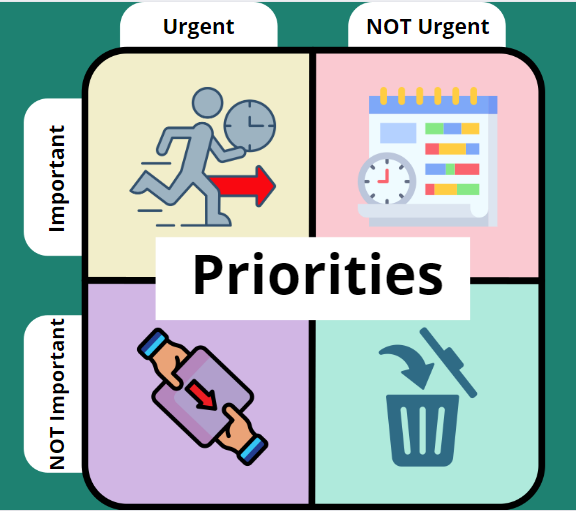
Try to invest as much as possible in the ‘Important & Not Urgent’ quadrant. These are the things that are most important in the long term but do not require immediate action. By proactively making time for these, you prevent everything from becoming urgent and stressful. Read more about proactive behavior:
- Proactivity: The Key to Conscious Parenting
- The Circles of Influence and Concern: Discovering the Power and Growth as a Parent and as a Family
Most of us spend too much time on what is urgent and not enough time on what is important.
Stephen Covey
Conclusion
As a parent, you play a crucial role in the personal growth of your child. But to do this well, you must also take good care of yourself. By consciously setting priorities and making time for what’s important, you create more balance and enjoyment in your family life. Remember:
- Identify your values and let them guide your priorities
- First schedule your ‘big rocks’
- Be proactive and make time for important, non-urgent matters
- Dare to say ‘no’ to less important commitments
By applying these principles, you set a good example for your children and invest in their growth and yours. What first step will you take today?
Do you want to read more?
- The 7 Habits of Highly Effective People – Stephen Covey
- The 7 Habits of Highly Effective Families – Stephen Covey
Do you want to watch more?
References
- https://www.goedgezind.be/babys/prioriteiten-stellen-als-ouder-moet-ik-dit-nu-doen/
https://www.rtlnieuws.nl/lifestyle/artikel/5367655/ouders-onder-hoogspanning-marie-anne-vanderhasselt-boek-stress-onderzoek - https://tijdvoortimemanagement.nl/ouders/
- https://www.jeugdenvrede.be/de-cruciale-rol-van-opvoeding-in-persoonlijke-groei/


