
Introduction
In a world where we’re constantly striving for growth and improvement, understanding how to translate our life vision into tangible actions is crucial. In a previous article titled ‘Developing Your Life Vision in Balance: The Wheel of Life’, we discussed the process of crafting a life vision. Now, we’re taking it a step further by exploring how to translate that vision into specific behaviors. This article aims to guide you in actualizing your life vision through the power of habit formation.
The Importance of Habitual Behavior
It’s often the small things that make the biggest difference. Small, frequently repeated behaviors, also known as habits, have a more significant impact on our lives than one-off grand actions.
The Domino Effect
Picture a line of dominoes, each one slightly larger than the last. The first domino is so small it’s barely visible. Yet, despite its diminutive size, it has the power to topple the next slightly larger domino. This domino, in turn, topples the next, and so on, until a domino many times larger than the first is knocked over.
This illustrates the power of small habits. The first, small habit may seem insignificant on its own. But it sets off a chain reaction leading to significant changes. Each small habit you add is like another domino in the line, contributing to the cumulative impact.
Small is Mighty
This concept is backed by scientific research. According to a study by Gardner, Lally, and Wardle (2012), it’s our daily habits that shape our lives and help us achieve our goals[1]. It’s not the grand, one-off action that leads to success, but the small, consistent actions we take every day.
Therefore, forming habits is a potent tool for personal growth and development. By choosing small, manageable behaviors and consistently performing them, we can gradually bring about significant changes in our lives. It’s the power of small habits that helps us actualize our life vision.
Why Goals Don’t Lead to Long-Term Results: Insights from James Clear
Are SMART Goals Always Smart?
Goal setting is a commonly used strategy for achieving success. However, according to James Clear, author of “Atomic Habits,” achieving goals in and of themselves doesn’t lead to sustainable results. This is because goals often focus on a specific outcome, not the underlying processes and habits needed to achieve that outcome.
Take, for example, the goal to lose 10 kilograms. It’s a specific and measurable goal, but what happens once it’s achieved? Often, we see people revert to their old habits once they’ve reached their goal. They stop dieting, reduce their gym visits, and eventually regain the weight. This is because their motivation was focused on achieving a specific goal, not on changing their lifestyle in the long term.
Moreover, goals have an endpoint. Once we achieve a goal, we may feel like we’re done and revert to old habits. This is why people often relapse after achieving a goal, such as losing weight or quitting smoking.
Identity-Based Goals
That’s why Clear suggests focusing on identity rather than goals. Identity-based goals are about who you want to become, not what you want to achieve. Suppose you decide you want to be a healthy person. This isn’t a specific, measurable goal, but a change in your identity. You start making healthier choices, not because you want to reach a certain weight, but because it aligns with your identity as a healthy person. These behavior changes are sustainable because they’re not dependent on achieving a specific goal but are part of who you want to be.
Identity-based goals are centered on developing the habits and behaviors that align with the identity you want to create for yourself. They’re a powerful way to create andmaintain sustainable behavior changes.
From Aspiration to Concrete Behavior: The Methodology of BJ Fogg

But how do we translate our aspirations into concrete behavior? Behavioral scientist BJ Fogg offers a method. He introduces the concept of a “behavior swarm.” These are all the behaviors we can perform to achieve our aspirations. Within this swarm, we identify the “golden behaviors.” These are the behaviors that are both impactful and feasible.
Clarifying Your Ambitions
BJ Fogg offers a practical approach to move from aspirations and vague goals to effective behavior that suits an individual. The process starts with clarifying your ambitions. Suppose you have the ambition to live a healthier life. This is a broad goal, so it’s essential to make it more specific. Perhaps you want to eat more fruits and vegetables, exercise more, or quit smoking.
Exploring Behavior Options
Next, you explore behavior options. If your goal is to eat more fruits and vegetables, you might consider eating a salad for lunch every day, having a piece of fruit for a snack, or making a green smoothie for breakfast. It’s crucial to avoid intuitive guesswork and expertly choose the right solution. Maybe you don’t like salads, but you do enjoy cooking. In that case, you could try finding new recipes that include lots of vegetables.
Visualizing and Evaluating Behavior
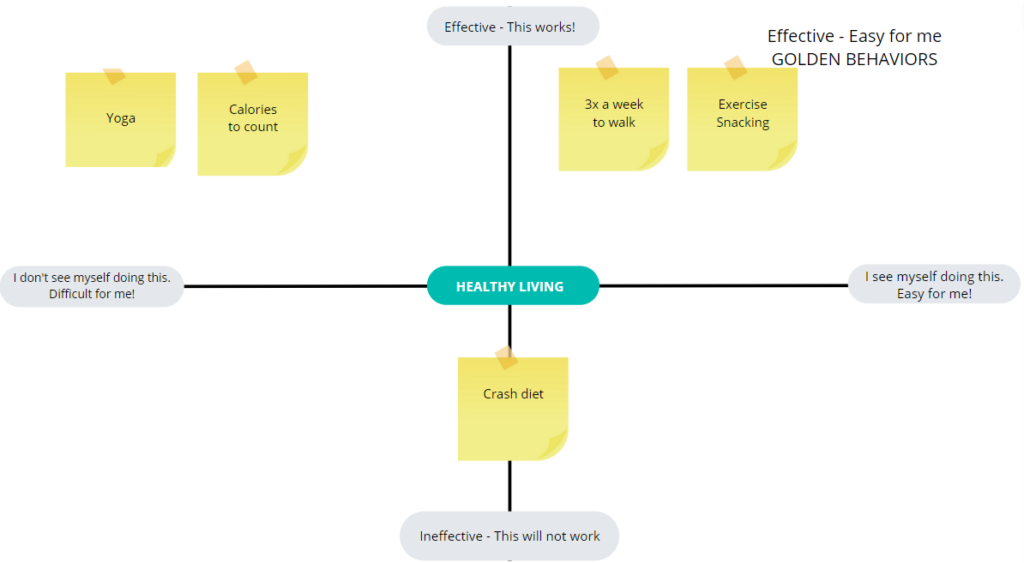
Now comes the practical part. Write each behavior action on a separate post-it and create an axis on a large sheet of paper or a whiteboard. The horizontal axis represents how effective the behavior is (from “not effective” to “very effective”), and the vertical axis represents how easy the behavior is (from “I don’t see myself doing this easily” to “I see myself doing this easily”). Place each post-it on the axis. Think about how effective and easy each action is, and place the post-it in the appropriate spot on the axis.
Choosing the Most Effective and Easy Actions
Look at your axis and choose the actions that are the most effective and easiest—your golden behaviors. These actions are probably the best to start with because they’ll give you the most significant impact for the least effort.
Experiment and Adjust
Experiment and adjust. Try out the chosen actions and move the post-its on the axis if you find an action is more effective or easier than you thought. It’s a dynamic process, and it’s okay to adjust your plan as you learn more about what works for you.
Effectively Converting Behavior into Habits
Now, to effectively convert these behaviors into habits, here are some additional tips:
- Make it easy: The simpler a task is, the more likely you are to do it. For example, if you want to eat more vegetables, make sure you always have pre-cut vegetables in your fridge.
- Make it attractive: Try to find ways to make the behavior more appealing. For example, if you want to start running, you could reward yourself with a tasty smoothie after each running session.
- Make it clear: Make sure you know exactly what you need to do and when you need to do it. For example, if you want to read more, you could decide to read for 20 minutes every night before bed.
- Make it satisfying: Ensure the behavior gives immediate satisfaction. This can be as simple as ticking off a task on your to-do list or celebrating your success with a friend.
- Be consistent: Consistency is key to forming new habits. Try to repeat your new behavior every day until it becomes a habit.
- Be patient with yourself: Forming new habits takes time. It’s normal to make mistakes and struggle. The most important thing is not to give up and keep going.
Recommendations for Forming Habits and Dealing with Failure

Nowthat we’ve explored the importance of habits and how to form them, it’s time to share some practical tips and strategies for creating new habits.
One of the most effective ways to form a new habit is by linking it to an existing habit. This is also known as ‘habit stacking.’ For example, if you drink coffee every morning, you could use this moment to form a new habit, such as reading a chapter from a book.
It’s also important to be realistic and start with small steps. Don’t try to implement a massive change all at once, but start small and gradually build up. This makes it easier to maintain the new habit and reduces the likelihood of failure.
But what if you fail? Failure is a normal part of the process and something we all encounter. The key is not to get discouraged. See failure as an opportunity to learn and adjust your strategy. Reflect, and make every effort to resume your good habit the next day! Create a powerful identity of a person who can stick to their objectives. Lastly, remember that forming new habits takes time, and it’s okay to take a step back now and then.
Conclusion
Forming habits is a powerful way to actualize your life vision and achieve your goals. By focusing on small, frequently repeated behaviors instead of one-off grand actions, we can bring about sustainable changes in our lives.
We’ve also seen the importance of setting goals based on our identity, rather than solely on specific outcomes. And we’ve discussed a method to move from aspiration to concrete behavior, using BJ Fogg’s methodology.
Now it’s your turn. Start forming new habits today and see how they can transform your life. Remember: the power of small habits should not be underestimated. They can help you actualize your life vision and bring you closer to your goals. Good luck!
References
- “Atomic Habits” by James Clear is a groundbreaking book that emphasizes the power of small habits and offers practical strategies to form and break effective habits, enabling significant changes in our daily lives. The book combines inspiring stories, scientific research, and practical tips to help readers transform their behavior and achieve long-lasting success.
- “Tiny Habits” by BJ Fogg is a revolutionary book that introduces the concept of mini habits and teaches readers how to use small, achievable actions to bring about lasting behavior change. The book provides concrete strategies and scientifically backed techniques to build positive habits and break negative patterns, focusing on simple steps that have an immediate impact.



Your article helped me a lot, is there any more related content? Thanks!