
Hello there! In previous blog posts, we’ve discussed forming new, positive habits. Today, we’re diving into a topic that affects us all: breaking bad habits. Whether it’s overindulging in sweets, spending too much time on social media, or in my case, drinking too much coffee, we all have a habit we’d like to change. But how do we do that? How do we break the cycle of unwanted behavior?
To answer this question, we turn to the insights of BJ Fogg, a leading behavioral scientist from Stanford University. Fogg has developed a method for changing behavior that is both effective and accessible. His approach is based on the idea that behavior change isn’t about willpower, but about systematically addressing the factors that influence our behavior.

My Bad Habit: Excessive Coffee Drinking
Before we dive into the details, I want to share a personal story. I’m generally a disciplined person. I stick to my diet, exercise regularly, and live healthily. But there’s one habit I struggle with: drinking coffee. At work, coffee is always available, and I find it hard to resist the temptation. I drink too much coffee, to the point where it affects me: heart palpitations and sometimes even panic attacks. I feel worse because of it, but I can’t bring myself to drink coffee in moderation. This is my personal struggle, and I hope that by sharing my experiences and Fogg’s insights, we can learn together how to break our bad habits.
Fogg’s Perspective on Bad Habits
According to Fogg, we should view bad habits as knots in a rope. It’s a complex tangle of specific behaviors that hang together. Each knot represents a behavior we want to change. Most people try to pull the entire rope. They want to change everything at once. I don’t want to eat unhealthy anymore! Well, that’s a whole bunch of behaviors, each with their specific trigger, ability, and motivation.
Even in my case of excessive coffee drinking, there’s a complicated knot:
- I drink coffee when I wake up
- I drink coffee when I arrive at work, before greeting my colleagues
- I drink coffee when I feel stressed
- I drink coffee when I have a dip
- I drink coffee when I just pass by the coffee pot
- I drink coffee at meetings
It might be better to untangle this cluster, which forms a knot, one by one. This might take a bit longer, but the chance of success is greater. Moreover, I don’t have to see it as an all-or-nothing situation. Then I always feel like I’m losing something. No, I can choose when yes, when no. This is also what I really want.
Fogg’s Masterplan for Behavior Change
Fogg’s approach to behavior change consists of three phases: creating new habits, stopping a habit, and replacing old habits. Each phase contributes to breaking bad habits in a different way.
Creating New Habits
In the first phase, creating new habits, we learn how to develop positive behaviors that help us achieve our goals. This can range from developing a daily meditation practice to learning a new language. The idea is that by creating new, positive habits, we can change our identity and displace old, unwanted habits.
How we create new habits we have discussed extensively in previous blog posts. But I repeat once why they can help to get rid of old habits. For example, I couldcreate a new habit of drinking more water. My algorithm could be: “When I wake up, I drink a glass of water”. “I set my timer every 90 minutes. When it goes off, I drink a glass of water.”. This drinking of water could have an effect on drinking coffee.
For example, I notice that I drink (even) more coffee when I’m stressed. I could start a meditation habit to better cope with stress. Or I could do a relaxation exercise every time I feel stressed. This could not only help reduce my coffee consumption but could also lead to a positive change in how I see myself – no longer as someone struggling with a coffee addiction, but as someone making healthy choices for their body and mind.
Stopping a Habit
Fogg’s Approach
In the second phase of Fogg’s approach, stopping a habit, we learn how to stop a habit by changing the motivation, ability, or trigger. This is based on the Fogg behavior model, which states that if there is no trigger, there will be no behavior. If there is a trigger, it depends on ability and motivation whether the intersection falls above or below the action curve.
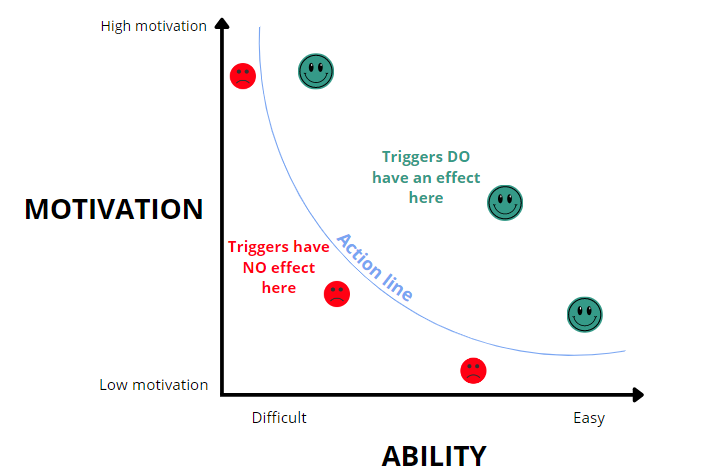
Addressing the Trigger
Fogg suggests first focusing on the trigger of a habit you want to stop. A trigger is the stimulus that initiates the behavior. In the case of excessive coffee drinking, there can be different triggers, depending on the circumstances.
Identifying the Trigger
In my case, the general habit is ‘excessive coffee drinking’, but this habit consists of several specific habits, such as:
- Drinking coffee in the morning after waking up
- Drinking coffee first thing when you arrive at work
- Constantly drinking coffee when you pass the coffee pot at work
- Drinking coffee during meetings
Each of these specific habits has its own set of triggers, ability requirements, and motivations. By focusing on unlearning these specific habits one by one, instead of trying to stop the general habit of excessive coffee drinking all at once, the process becomes more manageable and less intimidating.
Let’s take, for example, the habit of ‘drinking coffee first thing when you arrive at work’. The trigger could be entering your workplace, the ability is clearly present (you know how to make coffee and the machine is nearby), and the motivation can take various forms (for example, the need for an energy boost, or the social aspect of drinking coffee with colleagues).
Here are some possible triggers:
- The smell of fresh coffee.
- Seeing a coffee maker or a cup of coffee.
- Feeling tired or a dip in the afternoon.
- The company of colleagues who drink coffee.
- A certain time of day, for example, in the morning when waking up or after dinner.
- Stressful situations at work or at home.
- The completion of a task, as a kind of reward.
Removing, Avoiding, or Ignoring the Trigger
Now that you’ve identified some possible triggers, you can develop strategies to eliminate, avoid, or ignore them, as Fogg suggests.
- Remove the trigger: This means eliminating the stimulus that initiates the habit. For example, you could decide not to have coffee at home anymore or to store your coffee maker in a cupboard instead of leaving it visible on the counter.
- Avoid the trigger: This means avoiding situations that initiate the habit. Maybe you’ve noticed that you drink more coffee at work than at home. You could try changing your work environment by, for example, drinking tea instead of coffee during breaks or meetings.
- Ignore the trigger: This is the most difficult strategy, as it requires you to consciously resist the trigger. If, for example, you feel the trigger to drink coffee in the morning, you could try to ignore this urge and find an alternative activity to start your day, like going for a walk or doing a short workout.
Focusing on Ability
If focusing on the trigger doesn’t yield the desired results, then the next step is to focus on the ability. How easy is the unwanted behavior for you? Try to make it more difficult! You can focus on five aspects: time, money, physical effort, mental effort, and routine.
Let’s apply these to my situation:
- Increase the required time: You could reduce the accessibility of coffee, requiring more time to make a cup. This could be done by placing the coffee machine in a less accessible location, or by switching to a method of coffee-making that takes more time, like a French press or a moka pot.
- Make the habit more expensive: You could consider more expensive (but perhaps healthier) alternatives to coffee, like special teas or matcha. Switching to a pricier alternative might make you more resistant to overconsumption.
- Increase the required physical effort: Similar to increasing the required time, you could make the habit harder to carry out by requiring more physical effort. This could be done by grinding the coffee beans yourself instead of using pre-ground coffee, or by storing the coffee further away, requiring you to go up or down a flight of stairs to get to it.
- Increase the required mental effort: You could keep a log where you note down every cup of coffee you drink. This requires more mental effort and can make you aware of how much you’re actually drinking, helping you keep a better eye on your habit.
- Make the habit conflict with important routines: If you have a morning routine where you wake up early to exercise, drinking coffee late in the evening could disrupt your sleep and conflict with your morning routine. This could motivate you to drink less coffee, especially in the late hours.
Motivation
In addition to adjusting your ability, the next step in Fogg’s masterplan involves adjusting your motivation. This means finding ways to decrease your desire to perform the unwanted behavior. This could be done by emphasizing the benefits or rewarding yourself. You could also set up a challenge with a friend or family member. Together, you can motivate each other and hold each other accountable. This shared experience can help increase your motivation.
Fogg proposes two main strategies to decrease motivation to perform the unwanted behavior:
- Option A: Change the circumstances so that the motivation to perform the habit decreases.
- Option B: Introduce a demotivating factor. However, Fogg is not a fan of this method, as it often does more harm than good by creating unnecessary stress and conflicting motivations.
Let’s apply these principles to excessive coffee drinking:
For Option A, you can make changes to your daily routine that decrease the motivation to drink coffee. For example:
- Ensure you get enough sleep. If you’re well-rested, you might have less need for the energy boost that coffee provides.
- Eat a healthy, balanced breakfast. This can help keep your energy levels stable and reduce the need for a coffee boost.
- Try alternative drinks that contain less caffeine, like herbal tea. These can still provide a soothing morning ritual without the high dose of caffeine.
For Option B, as Fogg notes, adding a demotivating factor is often less effective and can lead to unnecessary stress. For example, it might be counterproductive to berate yourself every time you drink a coffee.
Instead of punishing or threatening yourself, focus on positive changes that decrease your motivation to drink coffee. Remember, the goal is to create a healthier lifestyle, not to punish yourself. It’s important to treat yourself with understanding and kindness during this process.
Replacing Old Habits

The third phase of Fogg’s approach is replacing old habits. This is where we learn to replace a bad habit with a good one. This is often the most challenging phase, as it requires us to change our behavior in a way that is sustainable and satisfying.
Fogg’s Approach
According to Fogg, the key to replacing old habits is to find a new behavior that provides the same benefits as the old one. This new behavior should be easy to do and something you enjoy. For example, if you’re trying to quit smoking, you could replace the habit of smoking with the habit of chewing gum. This provides a similar oral satisfaction and is much healthier.
My Approach
In my case, I could replace the habit of drinking coffee with the habit of drinking herbal tea. This would provide a similar ritual (making the tea, holding the warm cup in my hands, sipping it slowly), but without the negative effects of caffeine. I could also try to replace the habit of drinking coffee when I’m stressed with a healthier stress-relief habit, like going for a short walk or doing a few minutes of deep breathing.
Conclusion
Breaking bad habits is not easy, but with the right approach, it’s definitely possible. By understanding the factors that influence our behavior and using Fogg’s method of creating new habits, stopping a habit, and replacing old habits, we can make positive changes in our lives. Remember, it’s not about willpower, but about systematically addressing the factors that influence our behavior.
I hope this blog post has given you some insights and practical tips on how to break bad habits. If you have any questions or comments, feel free to leave them below. And remember, change is a process, not an event. Be patient with yourself and celebrate your progress, no matter how small.
Want to Read or Watch More?
- Atomic Habits, James Clear*: “Atomic Habits” by James Clear is a groundbreaking book that emphasizes the power of small habits and offers practical strategies for forming and breaking effective habits, enabling significant changes in our daily lives. The book combines inspiring stories, scientific research, and practical tips to help readers transform their behavior and achieve long-term success.
- Tiny Habits, BJ Fogg*: “Tiny Habits” by BJ Fogg is a revolutionary book that introduces the concept of mini habits and teaches readers how to use small, achievable actions to effect lasting behavior change. The book provides concrete strategies and scientifically-backed techniques to build positive habits and break negative patterns, focusing on simple steps that have immediate impact.
References
- BJ Fogg’s Behavior Model
- Fogg Behavior Model – Stanford University
- Het Fogg Behavior Model: zo ontwerp je gedrag – Boom Management
- Fogg Behavior Model | Gedrag beïnvloeden – Effecty
- Fogg’s behaviour model — a framework for behaviour change | by Divya Ray – Bootcamp
- The Fogg Behavior Model: How to Trigger Behaviour Change – Growth Engineering
- The Fogg Behavior Model: How to Trigger Behavior Change – Daring to Live Fully
- The Fogg Model – Habit Weekly
- How to use Fogg’s behavior model to increase conversion – WiseStamp


Thanks for sharing. I read many of your blog posts, cool, your blog is very good.
Your article helped me a lot, is there any more related content? Thanks!